
Union County Criminal Docket Searches
Search ARCourts is the first stop for an online Union County Circuit Court criminal docket. Use Participants when you have a name. Use Cases when you have a case or citation number. The advanced search filters by date range, case type, docket code, county, and court location. Pick Union for the county. A precise number beats a common name almost every time.
Contexte feeds the public system its data. Circuit courts must submit filings, but only some district courts publish there. That gap affects Union County misdemeanor, ordinance, traffic, and preliminary felony entries. Some lower-court cases never show up there. Call the District Court in that situation. Do not assume no docket exists.
- Open Search ARCourts and choose Participants or Cases based on the information at hand.
- Enter a name, organization, case number, or citation number, then set Union County filters where useful.
- Open the matching result and confirm the court, filing date, judge, status, and charge information.
- Read the newest docket line and future event before relying on an older setting.
- Ask the correct clerk for an official docket sheet, disposition, order, or certified copy.
Union County Criminal Docket Levels
One criminal case can pass through two Union County courts without staying in both. The Union County District Court handles misdemeanors, traffic and ordinance violations, and preliminary felony matters. Felony prosecution belongs to Circuit Court. That split is why a first appearance may sit on the lower docket. Later felony filings land on the Circuit Court docket.
| Court | Criminal docket role | Record contact |
|---|---|---|
| Circuit Court | Felony prosecutions and other circuit criminal matters | Union County Circuit Clerk, 870-864-1940 |
| District Court | Misdemeanors, ordinances, traffic, and preliminary felony steps | District Court Clerk, 870-864-1950 |
Read the court named in the header before doing anything else. Not every criminal event filed in El Dorado lands on the same docket or with the same clerk.
Criminal Dockets: What They Show
A Union County criminal docket is a chronological index. It is never a verdict on its own. The Search ARCourts data model covers a case number, case type, filing date, county and location, and assigned judge. It also lists participants, charges, pleas, settings, sentences, dispositions, and linked public documents when available. The official clerk-review manual shows how filings become reviewed docket entries. It makes no promise about public access. Some fields or filing images in a given case stay out of view.
The Arkansas Judiciary overview of Circuit Courts describes the general-jurisdiction court and its subject-matter divisions. Its illustration of the court structure is simple. Felony prosecutions sit on the circuit docket.
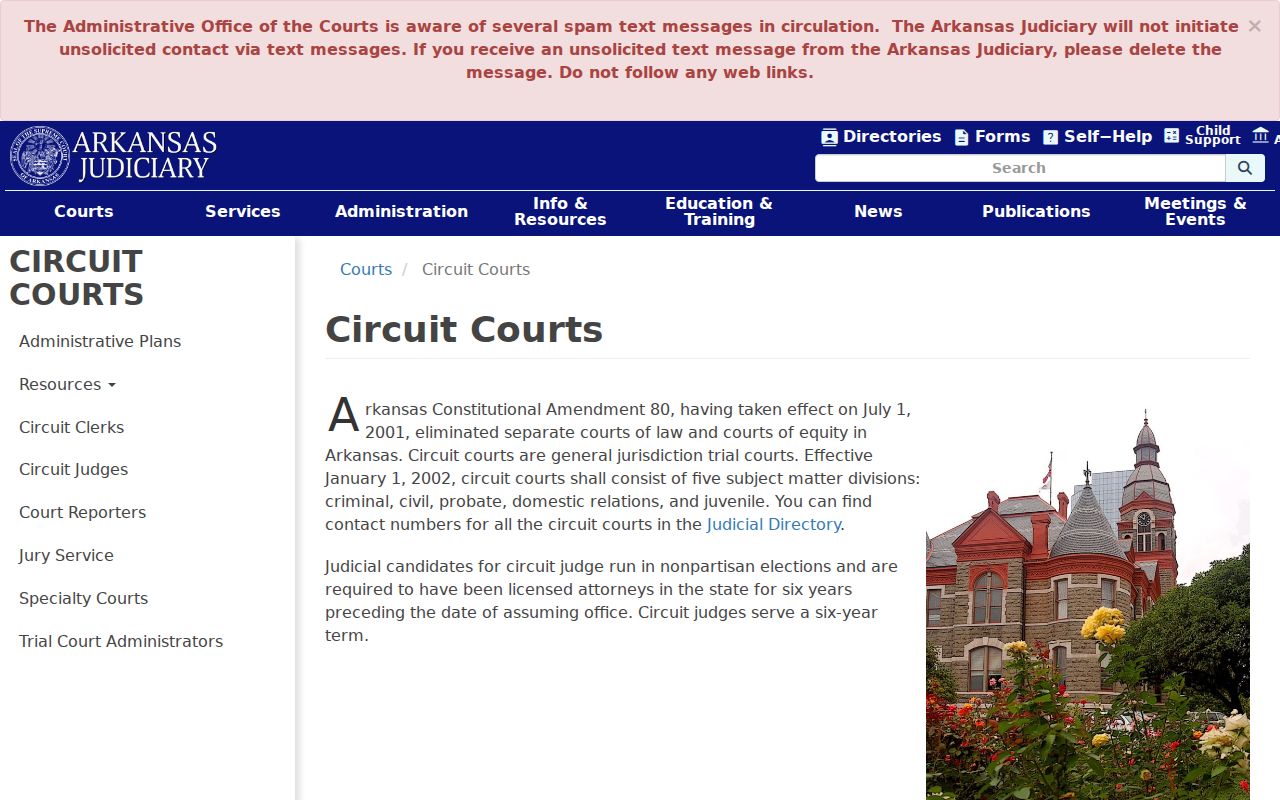
That structure is the reason to read the case header, location, and judge first. Only then should you interpret the individual criminal docket lines.
| Case identifier | A court-assigned number such as 10CR-09-100; use the exact characters shown. |
|---|---|
| Charge block | Charge number, code, description, level or text, and violation date when published. |
| Docket line | Sequence, code, description, text, type, and filing date for one recorded action. |
| Future event | A published date, time, type, and description that still needs confirmation after resets. |
| Outcome | Plea, sentence, milestone, judgment, or disposition information, depending on the record. |
| Document | A linked filing only when the document is public and available through the system. |
Union County Criminal Docket Outcomes
Read criminal entries in order. A charge only states an allegation. A plea records the answer to that charge. A disposition records an outcome, and sentencing may sit on a later entry or date. Those lines can sit close together yet mean very different things. Multiple charges in one Union County case can also end in different ways.
- Charge
- The alleged criminal or ordinance violation, not a finding of guilt.
- Plea
- The recorded response to a charge, such as guilty, not guilty, or no contest when allowed.
- Disposition
- The recorded resolution of a charge or case, including dismissal or conviction where applicable.
- Bond forfeiture
- A separate enforcement event that is not a substitute for the charge disposition.
- Reset
- A move of a scheduled event to another date without erasing the earlier docket history.
Trace each charge line to its own linked outcome. A filing, hearing notice, or old setting cannot stand in for the newest court action.
Criminal Case Stages on the Docket
A Union County prosecution does not always use the same set of entries, but the docket often follows a recognizable course: Filing → Arraignment → Pretrial → Plea or Trial → Disposition → Sentencing. The initial filing opens the criminal case history. An arraignment addresses the charge and plea. Motions, bond orders, counsel entries, and pretrial settings may then build the record before a plea or trial.
Do not treat the stages as a checklist of events that must have happened. Some cases end before trial. Others carry many motions, resets, or hearings. A disposition can resolve one charge while another stays pending, and an appeal opens a separate reviewing-court docket. Begin at the case header and follow the sequence numbers. Stop at the newest entry that matters.
Note: A future event is only a published setting. It is not proof that a later order left it unchanged.
Union County Drug Court Docket
The Thirteenth Judicial Circuit administrative plan documents Union County Drug Court as a local specialty program. It began in January 2002. The program generally meets twice each month, on the first and third Thursdays, at the Union County Criminal Justice Facility in El Dorado. Entry depends on treatment need, an eligible offense and history, and a prosecutor recommendation.
Drug Court keeps no public roster. The underlying criminal case number stays the docket reference, so follow that case and respect any access limits. The schedule is a program rhythm. It is not a promise that a given participant appears on a stated date. A dated 2020/21 circuit plan lists older programs. That listing alone does not prove each still runs. Confirm any live setting through the current case record and the court.
Key point: Use the underlying Union County criminal case number. Do not look for a separate list of Drug Court participants.
Union County Criminal Docket Courts
Arkansas gives its Circuit Courts general trial jurisdiction. Union County sits in the Thirteenth Judicial Circuit, which has six judges. Some divisions keep chambers right in the El Dorado courthouse. Others sit in Camden or Magnolia. That chamber address has nothing to do with where the Union County criminal docket lives. The clerk, not the judge's office, keeps it.
For circuit criminal records, contact the Union County Circuit Clerk in Suite 201 of the courthouse at 101 North Washington Street in El Dorado. The office lists weekday hours of 8:00 a.m. to 4:30 p.m. Its records phone is 870-864-1940. Lower criminal matters belong to the District Court Clerk at 250 American Road #A, El Dorado, 870-864-1950. That office posts no counter hours, so call ahead before you go.
Skip the chambers when you need copies. Start with the clerk of the court where the case was filed. Once you know the assigned judge and reporter. Transcript requests then go to the court reporter.
Missing Union County Criminal Dockets
An empty Search ARCourts result is not proof. A Union County criminal case may still exist. The search itself may be flawed. A name on the docket may not match the name you typed. One dropped character in a case number breaks the lookup. Some District Court cases never enter the public statewide data at all. Sealing, limited electronic content, older records, or another lawful restriction can hide an entry too.
Run the exact case or citation number first. Then pick Union County and the right court location. If the District Court matter still does not appear, call 870-864-1950 and ask whether it was ever entered and whether a hearing is currently set. For Circuit Court, use 870-864-1940. Give the case number, the record type you want, and the rough filing or event date. The clerk can tell you what public record exists, and an online absence is never a result.
Access Rules for Criminal Dockets
Arkansas Administrative Order 19 leads on court-record access. It keeps confidential anything made secret by law, court order, or rule. That covers Social Security numbers and listed financial identifiers. Sealed or expunged information stays hidden too. The same goes for protected addresses and deliberative material. The public side of a Union County criminal docket still carries real value. But filing electronically does not turn a confidential field into a public one.
The Comprehensive Criminal Record Sealing Act, Ark. Code §§16-90-1401 et seq., governs criminal sealing. Ark. Code §9-27-309 handles juvenile confidentiality. A public request cannot break a seal. Someone legally entitled to restricted material may have to show identity, party or counsel status, or authority under a court order. Union County publishes no checklist for this, so expect to make your case to the clerk directly.
Public access rule: Search ARCourts omits restricted data. Ask the clerk what may lawfully be released, and never infer the reason for a missing entry.
Official Union County Criminal Dispositions
A free docket print is a fine tool. It helps you find the right case and outcome entry. Search ARCourts says plainly that its output is not an official court record. So when you need a certified disposition, start with notes. Write down the case number, charge, disposition line, and date. Then go to the office that holds the record. Circuit criminal records sit with the Union County Circuit Clerk; lower criminal records sit with the District Court Clerk.
The Circuit Clerk's recording-fee block lists $0.50 per page for plain copies. Certified copies run $5, and authenticated copies run $15. Confirm the rate covers the court document you want. Ask about page count, certification choice, total cost, accepted payment, delivery, and any ID rule before you send money. Union County offers no dedicated criminal-copy form, no promised turnaround, and no complete mail procedure.
Know the difference among products. A docket sheet, a filed order, and a certified disposition are three distinct things. Name the exact one you need. That way you avoid paying for a useful case history. What you truly needed was an authenticated outcome.